![InnoVintSupportCenter - header.png]](https://support.innovint.us/hs-fs/hubfs/InnoVintSupportCenter%20-%20header.png?width=300&height=22&name=InnoVintSupportCenter%20-%20header.png)
This article describes how to use bulk components to generate new lots without requiring specific vineyard blocks. Track bulk juice and wine the way you receive it: with vintage, varietal and appellation linked together, each with its own percentage.
InnoVint is currently transitioning to an upgraded bulk component composition functionality.
If your winery account was setup before June 2026, you will have our original bulk components feature. Not all of the functionality this article is currently available. We anticipate releasing this to all customers by the end of 2026.
If your account was set up after June 2026, jump to our updated component functionality below.
This article covers:
- What are bulk components?
- How to add a lot with bulk components
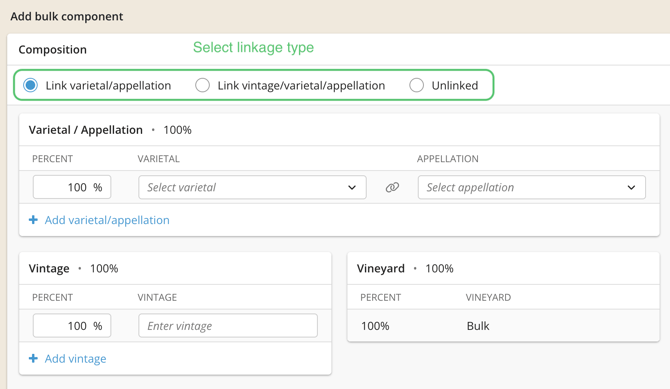
- Choosing a bulk linkage
- Viewing bulk components on a lot
- How bulk components behave in blends and transfers
- Importing lots with bulk components
- FAQ
What are bulk components?
A bulk component is a lot component that isn’t tied to one of your vineyard blocks. Use it for juice, wine, concentrate or other material you receive in bulk, or when you only know the vintage, varietal and appellation, or if you simply want to track a lot as bulk (without specified vineyard components).
- Varietals can be as broad or specific as you need. Here are some generic "varietals" currently available:
- Red - Red Wine, Other Red, Unknown Red
- White - White Wine, Other White, Unknown White
- Rosé - Rosé Wine, Unknown Rosé
For unknown concentrate sources or high proof alcohol, varietal choices also include:
-
- Red Concentrate
- White Concentrate
- Brandy
- Distilled Spirits
- You can also make the appellation as broad or specific as you like (the appellation list has options for a whole state, or you can even select N/A).
Have a component that is also non-vintage? See our article here for guidance on how to create a Non-Vintage lot or component.
Upgraded Bulk Components (post June 2026 wineries)
Bulk wine often arrives as a blend of several varietals, appellations and vintages. To label a finished wine with a vintage, varietal or appellation, you need to know how those attributes overlap. For example, how much of your Chardonnay came from Napa, not only that the wine is 80% Chardonnay and 90% Napa.
Upgraded bulk components let you link these attributes, so each line of the bulk component describes a real slice of the wine:
- Varietal, Appellation – for example, 50% Merlot / Napa Valley and 50% Malbec / Napa Valley, plus a separate vintage breakdown.
- Vintage, Varietal, Appellation – for example, 80% 2025 / Syrah / Napa Valley and 20% 2024 / Merlot / Napa Valley.
- Unlinked – vintage, varietal and appellation are tracked separately. This is the same way original bulk component functionality worked.
Example: A wine that is 70% Napa Chardonnay, 20% Napa Semillon and 10% Sonoma Chardonnay is 80% Chardonnay and 90% Napa. But only 70% of the wine is Chardonnay from Napa. With a linked bulk component, your composition shows that.
Original "unlinked" Bulk Components (pre June 2026 wineries)
At lot creation, you can create a lot using only vintage, varietal and appellation; InnoVint will not require a vineyard and block component. Each bulk component attribute - vintage, variety and appellation - will not be related.
You will not see an opportunity to link any of the attributes, and the bulk components will work "Unlinked".
How to add a lot with bulk components
- Go to the Lot Explorer and click + Add lot.
- Choose the lot type and fill in the lot attributes as usual.
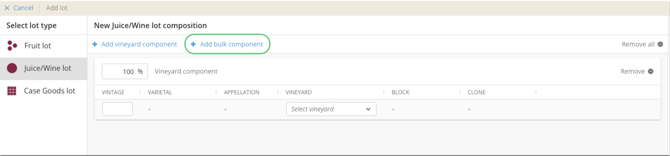
- In the components section, click + Add bulk component. A slide-over opens.
- In the slide over, choose a linkage option at the top: Link varietal/appellation (the default), Link vintage/varietal/appellation or Unlinked. See Choosing a bulk linkage below.
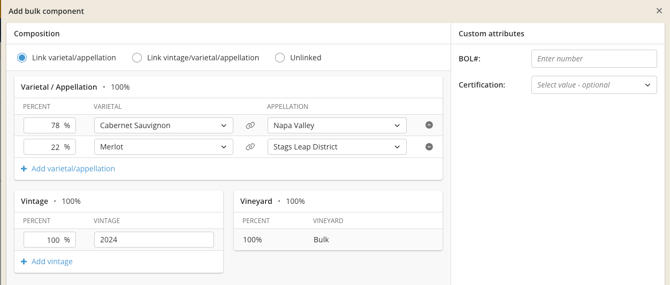
- Enter each line of the bulk component and its percentage:
- Vintage accepts four digit whole numbers only.
- Varietal and Appellation support the same options as when you create a vineyard, for every fruit type in your account.
- On a linked line, the varietal and appellation must be the same fruit type (for example, a Grape varietal with a Grape appellation). One bulk component can include lines of different fruit types.
- Click to add more rows. A remove button appears when a section has more than one row.
- Vineyard is always listed as Bulk at 100%.
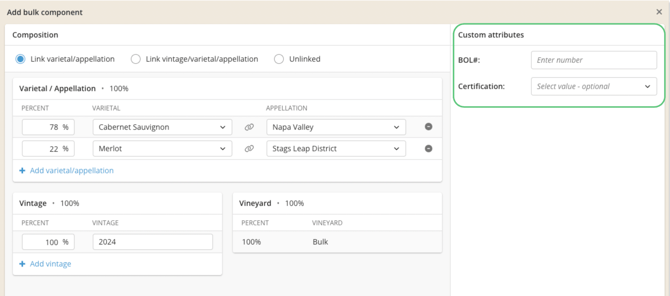
- If your account has component custom attributes, you can update them for each lot component. Enter them on the right side of the slide-over. If custom attributes are set as required at component creation, then attributes must be filled in. See more about creating Component Custom Attributes here.
- Save the bulk component. It appears in the lot’s components table, with a link icon between linked values.
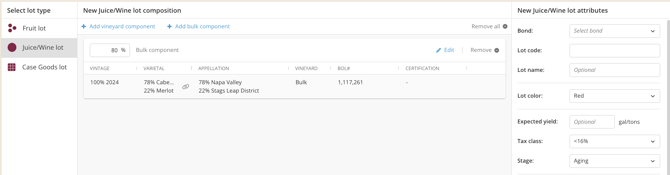
- Enter the bulk component’s % of the lot. You can also Edit or Remove it.
- Add more bulk components or vineyard components (+ Add vineyard component) as needed. A lot can have both.
- Check the bottom bar. It shows the number of components and their total percentage. The total must be exactly 100% (up to 4 decimal places), and it shows in red until it is.
- Click Add new lot. The bulk component is saved only when the lot is created.
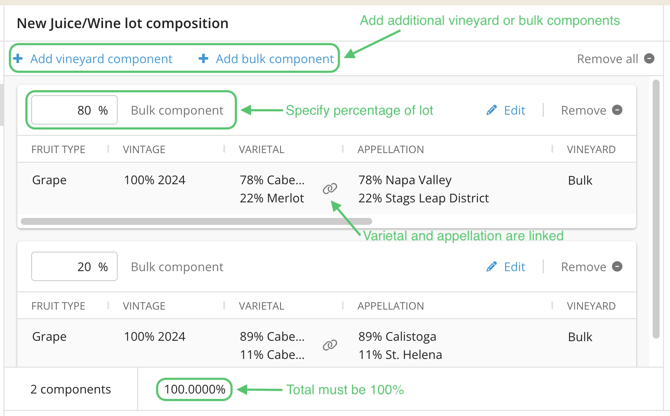
Tip: The lot color defaults from the first varietal of the first component, whether it’s a vineyard or a bulk component. You can always change it if needed.
Percentage rules
Within one bulk component, each attribute must total 100%:
- Vintages total 100%
- Varietals total 100%
- Appellations total 100%
Across the lot, all components (vineyard and bulk) must total 100%.
Choosing a bulk linkage
|
Linkage |
How you enter it |
Use it when |
|---|---|---|
|
Link varietal/appellation (default) |
Each row is a varietal + appellation pair with a %. Vintages are listed separately below. |
Your paperwork links varietal and appellation, and the vintage breakdown applies to the whole wine. |
|
Link vintage/varietal/appellation |
Each row is a vintage + varietal + appellation with a %. |
Your paperwork breaks the wine down by vintage, varietal and appellation together. |
|
Unlinked |
Vintage, varietal and appellation are each entered as separate lists. |
You only know each attribute’s overall percentage. |
Changing the linkage
You can switch linkage in the slide-over. InnoVint keeps the data you’ve entered wherever it can. For example:
- Varietal/Appellation → Vintage/Varietal/Appellation: with one vintage, each varietal/appellation row picks up that vintage. With more than one vintage, InnoVint creates a row for each combination and leaves the percentages blank for you to fill in.
- Any linkage → Unlinked: vintages, varietals and appellations are split into separate lists with their totals.
- Unlinked → linked:
- Varietal/Appellation
- Each varietal row picks up each appellation. InnoVint creates a row for each combination and leaves the percentages blank for you to fill in. Vintage percentages remain filled in.
- Vintage/Varietal/Appellation
- InnoVint creates a row for each combination and leaves the percentages blank for you to fill in.
- Varietal/Appellation
Always review the percentages after switching linkages!
Viewing components on a lot
Via Lot details Composition tab
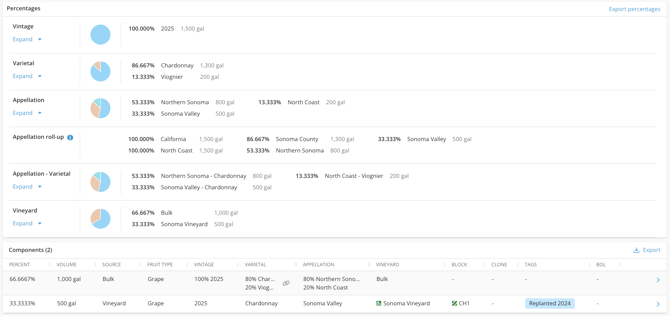
To view bulk components on a lot, click Lot details > Composition tab. The components table is located below the composition percentages.
Components table
The components table lists each component with:
- Percentage and volume (and weight, if the lot is in weight)
- Source: Vineyard or Bulk
- Fruit type (only if your account has more than one fruit type)
- Vintage, Varietal, Appellation, with link icons between linked values for bulk components
- Vineyard, Block, Clone (bulk components show Bulk as the vineyard, no block or clone)
- One column per component custom attribute, after Block tags
Click a vineyard row to open its block details. Click a bulk row to open the Create lot action details where the bulk component was entered.
Percentages
- Bulk vintages, varietals and appellations are included in each chart and in the Appellation roll-up.
- Appellation - Varietal:
- Linked bulk components show their varietal/appellation pairs.
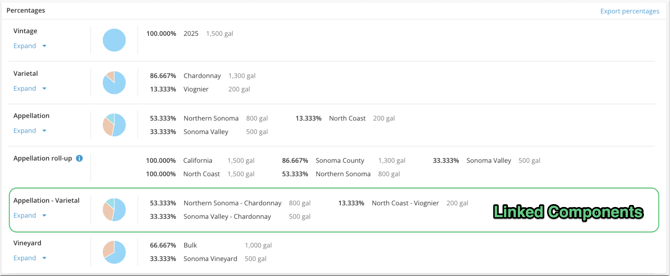
- Linked bulk components show their varietal/appellation pairs.
-
- Unlinked bulk components show as N/A.
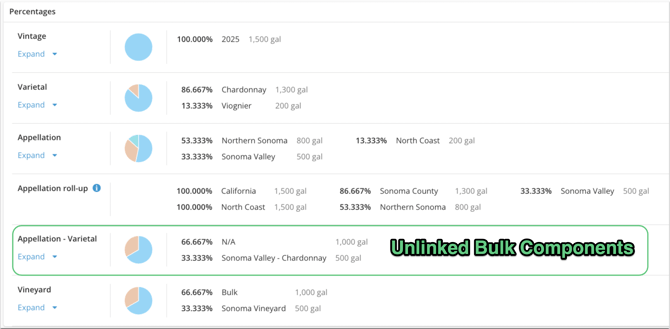
- Unlinked bulk components show as N/A.
- Vineyard: bulk components show as Bulk.
- Export percentages includes the same data.
Via the Create lot action details
Open the lot’s History tab and click the Create lot action.
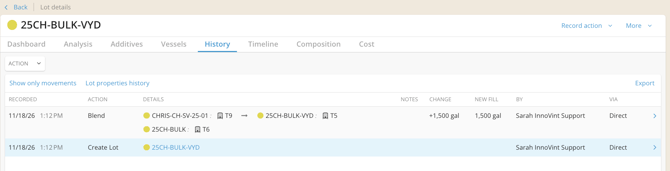
If the lot’s composition was set when the lot was created, the Create lot details page shows a Components table with the composition as originally entered: Percent, Source, Fruit type, Vintage, Varietal, Appellation, Vineyard, Block, Clone and component custom attributes.
You can also add, edit and delete Notes on the Create lot action details page.
Lots created inline from another action (for example, during a transfer or blend) don’t have a Components table on this page. Their composition is set from the drained lots on that action, and cannot be edited.
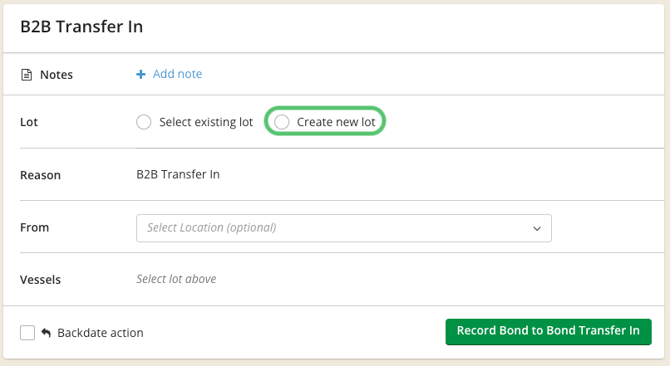
Lots created inline via B2B Transfer In do set the original lot composition, and will show a Components table.
Editing a lot’s original composition
From the Create lot action details page, click Edit below the Components table to edit the lot’s full original composition, vineyard and bulk components included. Or click Edit on a bulk component row to open that bulk component directly. The edit form opens with your existing data.
- Users with Team Member or Team Member (Cannot Submit) permissions can edit only the most recent action. Admins can edit the action dated within the last 14 months (430 days). All edits also follow your winery’s lock backdate setting.
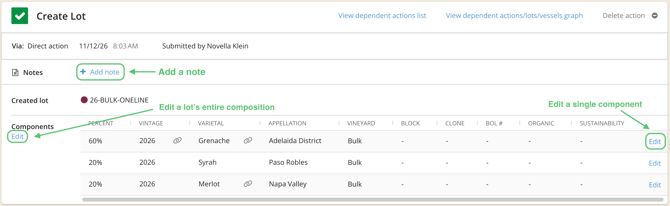
Downstream lots that this lot was blended into will update to reflect the composition edit.
How bulk components behave in blends and transfers
- Blending: bulk components contribute to a blend in proportion to their share of each lot, like vineyard components.
- Bulk components stay separate. Two different bulk components don’t merge when blended, even if their composition is identical, so each one traces back to the lot where it was entered. If the same bulk component comes back together after a split, it shows as one row again.
- B2B transfers: bulk components are copied to the destination lot for B2B within winery and B2B to another InnoVint winery.
- Note: component custom attributes don’t carry over on B2B transfer to another InnoVint winery.
Creating a lot inline on B2B Transfer In
On a B2B Transfer In action or work order task, you can create the receiving lot inline. The full Add lot form opens in a slide-over, so you can enter vineyard and bulk components there.
Importing lots with bulk components
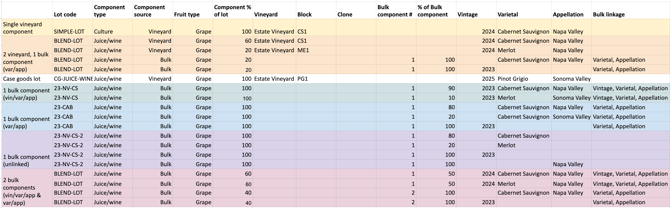
You can create lots with bulk components through Lot Explorer → Import lots (the arrow next to + Add lot). Download the example CSV from the import page for the correct template.
Each row is one line of a component.
|
Column |
What to enter |
|---|---|
|
Component source |
Vineyard or Bulk. Optional if every component is from a vineyard. |
|
Component % of total lot volume |
The component’s share of the lot. Repeat it on every row of the same bulk component. |
|
Bulk component # |
Numbers the bulk components within a lot (1, 2, 3…), so rows for the same bulk component stay together. |
|
% of Bulk |
The row’s share of the bulk component. |
|
Bulk linkage |
Vintage, Varietal, Appellation or Varietal, Appellation, or blank for unlinked. Optional if the lot has no linked bulk components. |
|
Vintage, Varietal, Appellation |
The values for the row. |
|
Fruit type |
Only if your account has more than one fruit type. If blank, InnoVint uses your account’s only fruit type. |
|
Component custom attributes |
One column per attribute, at the end. Values apply to bulk components only. Vineyard component values are set in Block details → Vintages. |
Allowed:
- Unlinked: separate rows for each vintage, varietal and appellation, each with its own % of Bulk.
- Vintage, Varietal, Appellation: one row per vintage/varietal/appellation with a % of Bulk.
- Varietal, Appellation: varietal/appellation rows (no vintage) plus separate vintage rows, all with linkage Varietal, Appellation.
Not allowed:
- Vintage, Varietal or Vintage, Appellation linkages
- Percentages that don’t total 100%
- A vintage on a varietal/appellation row of a Varietal, Appellation bulk component
- Missing values on a row that needs them
- The old Juice/Wine - Bulk format. The import shows an error that explains how to fix the row.
If any row fails, the whole file will be rejected and no lots are created. You will need to fix the errors and upload again.
📌 Tip: Column order and headers must match the example file exactly.
FAQ
Q: I onboarded my InnoVint winery account in July 2026, what happened to my existing bulk component lots?
A: Any lots with bulk components that existed prior to the upgrade were converted to unlinked bulk components. Your lots’ compositions didn’t change. Bulk components that were merged in earlier blends were split back into separate components, and the lot’s overall composition stays the same.
Q: Can a lot have both vineyard and bulk components?
A: Yes. Add both on the same lot. All components together must total 100%.
Q: How can I find a lot created with bulk components?
A: You can filter for lots including bulk components in a few ways:
1) The Lot Explorer’s Vineyard filter has a Bulk option that will find all lots with bulk components. It can take a few minutes to appear after your first bulk lot.
2) The Vintage, Varietal and Appellation filters in the Lot Explorer, Vessel Explorer, lot pickers and Custom Reports include bulk component attributes. If the bulk component attribute is <75%, consider using the Vintage Component, Varietal Component and Appellation Component filters instead.
Q: Can I create a Case Good lot with bulk components?
A: Yes. Case Good lots support bulk components at lot creation.
Q: Can I create a Fruit lot with bulk components?
A: No. Fruit lots must be created via a vineyard component.
Q: How can I export my lot compositions and components (including the bulk ones)?
A: You can find composition components in the following exports:
- Lot Explorer → Export → Lot components
- Lot details → Composition → Components → Export components
- Block details → Lots → Export