![InnoVintSupportCenter - header.png]](https://support.innovint.us/hs-fs/hubfs/InnoVintSupportCenter%20-%20header.png?width=300&height=22&name=InnoVintSupportCenter%20-%20header.png)
What is the Calculated Additives Feature?
The Calculated Additives feature helps you trace and track additive amounts in your wine and juice lots—automatically. It’s especially useful for blending and label compliance, as well as ingredient tracking and allergen disclosures.
As wine is moved, blended, or removed from InnoVint, culmulative additive amounts in each lot are recalculated and tracked to ensure your compliance records and product makeup stay accurate.
This article contains
- How it Works
- Where to Find Calculated Additive Information
- When Do Additive Amounts Update?
- How Additives Are Calculated
- FAQ
How It Works
Additive Tracking
-
When you record an Addition to a juice/wine lot, InnoVint tracks the additive type, product, batch and amount.
-
As wine moves (via transfer, topping, blends, etc.), additive amounts contained in the lot contents are proportionally recalculated based on volumes.
-
If an action is edited or backdated, the additive amounts update accordingly.
-
Please note that there is a backdating limit for Additions: Addition actions may only be backdated up to 14 months (430 days). If exceeded, you'll see this error:
“Unable to record this action. Addition actions may not be backdated more than 430 days.”
-
Snapshots on Wine Removal
When wine leaves your system (e.g., via bottling, B2B transfer out or volume adjustments), InnoVint captures a snapshot of all additive products and their calculated amounts at that moment. These are included in the "Removed Additives Export".
Additive amounts are proportionally calculated and associated to volume - because of this, an empty lot will not show any calculated additives.
If a lot is emptied via bottling, bond transfer, or a volume adjustment, you will see the snapshot of additives in the wine at that point in time via the Export: Removed Additives Export.
If a lot is emptied via a blend or transfer into a new lot code, the additives are removed from the emptied lot along with any volume, and carried into the downstream lot. This additive movement can be seen in the Additive Export Trace report.
Where to Find Calculated Additive Information
You can view calculated additive details in two main places:
1. Lot details > Additive tab
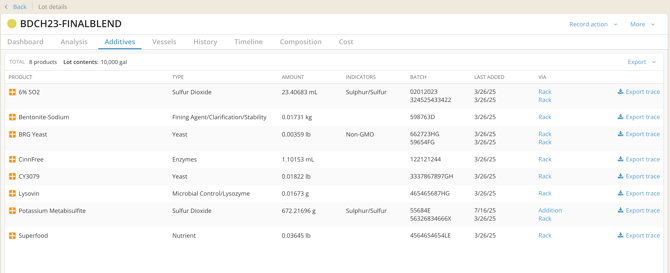
The Additive tab in the Lot details page contains the following columns to view the total amount of additives in the lot:
-
Product: Additive product name
-
Type: Product type (e.g., acid, enzyme)
-
Amount: Total calculated amount by product and units
-
Indicators: Any associated additive indicator designations (e.g., Allergen, Organic)
-
Batch: Up to 3 listed on-screen - all batches are listed in the export
-
Last Added: Displays the date of most recent action per batch
-
Via: Links to the action where additive was last added
- Export trace: trace the provenance of each batch, and understand how it got into the lot
2. Export
The Additive table includes an export with more detailed information. If your additives tab is empty, check here first if the lot was bottled or shipped out!
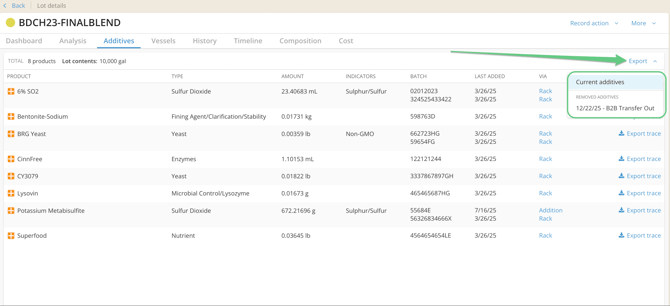
Find the Export button at the top right of the table - it provides you with two export options: "Current additives" and "Removed additives".
- The Current Additives export includes:
-
Additive Name (product name)
-
Batch ID
-
Current calculated amount & units
-
Additive Indicators
-
Date & Action of Last Addition of the batch
-
Action URL
-
- The Removed Additives export is a snapshot triggered when wine leaves the system. Includes:
-
Removed Volume/Weight
-
Removal Reason (indicates the action and the reason, ie Volume Adjustment: Inventory losses)
-
Additive Details (same format as above)
- Action URL
-
3. Export trace report
Don't understand where a batch comes from? The export trace will allow you to understand how a batch arrived in your wine's contents for each product.
The export contains a summary of the data involved:
-
The lot's volume or weight and a link to the Lot details page
-
Product data, including additive type, Indicators, product tags, and a link to the Product details page, as well as the the total amount of the product that the lot contains, and the number of batches of that product
-
Batch data, including the Batch ID, name, and amount, plus tags and a link to the Batch details page
- A table per batch, describing the pathways it took to reach the lot's contents
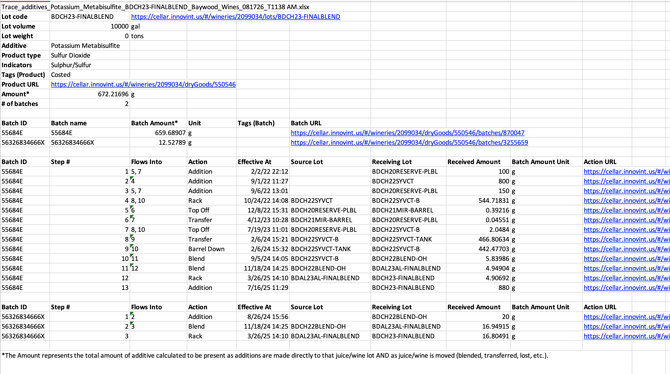
How to read the trace report's batch tables:
-
The batch tables lists all actions that fed into this lot code and the amount of batch received on the action
- An Addition action will always be the first step of every path
- The received amount from each action is only referencing that specific action, not necessarily the amount that came into the final wine (i.e. Step 1, Addition, is the entire addition amount to the original lot involved on the addition action, not the amount that is calculated in the final lot)
-
If a Blend contributes the same additive from 2 different source lots, they would appear as 1 line item - it would display the total contributed quantity of the additive from both lots
- This reports on all additions of additives that impacted this lot, it does not account for any additive removal
- The total of Received Amount does not equal the Amount currently in the wine
When Do Additive Amounts Update?
-
When wine is moved in/out of a lot (directly or via work order).
-
When a new or backdated Addition action is submitted.
-
When historical actions are edited or deleted.
-
On Bleed or Drain actions (for lots in weight) we distribute additives from the lot in weight into a lot in volume based on the special "Expected Yield for calculated additives" field that exists on these actions. This field defaults to the lot's expected yield, but can be updated independently and does not impact the lot’s expected yield.
A visual indicator will block access to the Additive tab during extended additive recalculations to avoid errors.

How Additives Are Calculated
-
Additives follow volume (similar to cost). A proportional amount will be removed from a lot via movement or an action loss.
- Additives are lost during action (inventory) losses, but we never add additional additives during a gain.
-
Additives are calculated in the addition unit, not inventory unit (e.g., mL, g) and are tracked to 5 decimal places.
-
Trace additive amounts remain visible (as "<0.0001") until the lot is completely emptied.
Special notes to keep in mind
-
When multiple batches are consumed in an addition, they are split based on the amount removed. If no amount is removed from a batch, then the additives per batch are applied equally to the involved lots.
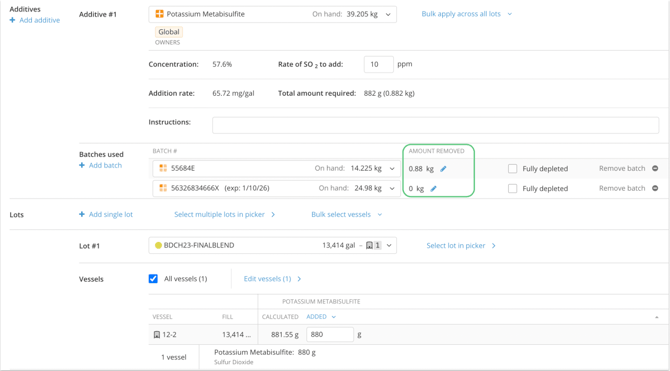
- B2B within winery and B2B to another IV winery actions do not transfer additives (but Transfer (Inter-facility) does!
- During an action which retains the lot code, if there is no volume change in the retained lot code, but there is a net gain on the action from another filled lot such as a lees lot, then additives are redistributed proportionally to all involved lots. The total additives overall will not increase across the filled lots, but the retained lot's additives will decrease (because they are distributed proportionally by volume into the other lot(s)).
FAQ
Q: I don't see my Additives tab on my case good lots!
A: Only juice/wine lots (when in volume and weight) support calculated additives. Fruit lots and case goods lots are not supported.
Q: I don't see the additives on my "from" blend lot component!
A: If a movement action drains ALL content from a lot (if volume and weight are equal to zero), all additives are cleared from that lot. This is because the Additives tab is intended to show how much, in absolute terms, of an additive is a part of the lot contents. If the lot contents are 0, then the additives are also gone. You can find these additives "transferred" into the filled lot(s).
Q: I bond transferred my lot into another InnoVint winery, but my lot at the new winery isn't showing any additives!
A: The "B2B within winery" and "B2B to another IV winery" actions do not copy additives into the new lot. For these actions, we recommend exporting the source lot's additive snapshot (from the B2B action). Then, re-record an Addition action with zero removed from the batch (this maintains your dry goods inventory), but adding the desired quantity into the lot, in order to add the additives back into the new lot. We do recommend doing an addition task per product batch instead of including all batches at once.